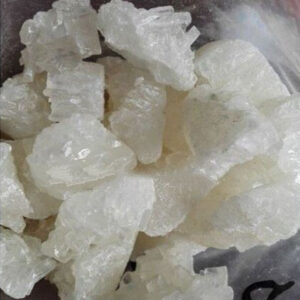
3-HO-PCP Crystal
3-Hydroxyphencyclidine (3-HO-PCP) is a dissociative of the arylcyclohexylamine class related to phencyclidine (PCP) that has been sold online as a designer drug.
3-HO-PCP acts as a high-affinity uncompetitive antagonist of the NMDA receptor via the dizocilpine (MK-801) site (Ki = 30 nM). It has much higher affinity than PCP for this site (Ki = 250 nM, for comparison; 8-fold difference).
The drug also has high affinity for the μ-opioid receptor (MOR) (Ki = 39–60 nM) in animal test subjects, the κ-opioid receptor (KOR) (Ki = 140 nM), and the sigma σ1 receptor (Ki = 42 nM; IC50 = 19 nM), whereas it has only low affinity for the δ-opioid receptor (Ki = 2,300 nM).
The high affinity of 3-HO-PCP for opioid receptors is unique among arylcyclohexylamines and is in contrast to PCP, which has only very low affinity for the MOR (Ki = 11,000–26,000 nM; 282- to 433-fold difference) and the other opioid receptors (Ki = 4,100 nM for the KOR and 73,000 nM for the DOR).
Although it was hypothesized that 3-HO-PCP might be a metabolite of PCP in humans, there is no evidence that this is the case. 3-HO-PCP is a metabolite of 3-MeO-PCP.
3-HO-PCP is an arylcyclohexylamine.[1] Close analogues of 3-HO-PCP include PCP, 3-MeO-PCP, 4-MeO-PCP, 3-MeO-PCMo, and somewhat more distantly ketamine, methoxyketamine, 3-MeO-PCE, methoxetamine and dimetamine.
3-HO-PCP was mentioned by a chemist under the pseudonym “John Q. Beagle” in 1999 in a post on The Hive. The psychoactive effects of 3-HO-PCP have been described by Bluelight users even before its availability as a research chemical in 2009.